Tree Doctor · Newcastle · Lake Macquarie · Hunter
Your tree is sick. Find out why before anyone starts the chainsaw.
Dieback, fungi, borer holes and sudden leaf drop are symptoms, not causes. Our AQF Level 5 consulting arborist finds what's really going on and gives you a written plan to treat it, manage it or remove it safely.
✓ On-site Visual Tree Assessment, root collar and soil checks
✓ A plain-English treatment plan with honest odds of recovery
✓ Removal only when it's genuinely the right call
☎ Call a Tree Doctor: 02 4003 4400Send Photos for a Free Assessment →
Since 2015
Servicing the Hunter
What a "tree doctor" actually is, and why the qualification matters
"Tree doctor" isn't a licensed title in NSW. Anyone with a ute can use it. What you actually want is a consulting arborist qualified to AQF Level 5 (Diploma of Arboriculture). That's the level City of Newcastle requires for arborist reports supporting tree permits, and the training that covers tree biology, pathology, soil science and risk assessment.
A tree lopper sees a branch problem. A tree doctor asks why the tree is shedding branches, thinning or declining. The answer is usually below ground: compacted soil, a severed root, waterlogging or a root-rot pathogen. Cutting off the symptom without fixing the cause is how healthy trees end up as removals a few years later.
Arborist's rule of thumb
"The canopy is the messenger, not the cause. When a Newcastle tree thins out, we look at the root zone first. Most of the decline we diagnose traces back to something that happened in the soil one to three years earlier: a new driveway, a trench for pipes or the NBN, a raised garden bed or a change in drainage."
Symptom checker: what your tree might be telling you
This table covers the problems we see most often across Newcastle, Lake Macquarie and the Hunter. Use it as a starting point. A proper diagnosis needs eyes on the tree, because several of these look alike from the ground.
What you're seeing
Common causes in the Hunter
How urgent?
Thinning crown, dieback from the top down
Root damage from construction or trenching, soil compaction, Phytophthora root rot, drought stress
Book an assessment within weeks
Mushrooms, brackets or white fungal sheets at the base
Armillaria (honey fungus), Ganoderma or other wood-decay fungi in the roots or butt
High. Decay can weaken root plates with little warning
Crusty white "lerps", sticky leaves, black sooty mould on gums
Psyllid infestation, usually on a tree that's already stressed
Moderate. Treat the stress, not just the insect
Holes, sawdust-like frass or gum bleeding from the trunk
Longicorn or other wood borers attacking a weakened tree
Moderate to high, depending on how much of the trunk is affected
Mud leads up the trunk, hollow sound when tapped
Termites (often Coptotermes) nesting in the trunk or root crown
High. Structural risk to the tree, and a possible pest risk to your home
Yellow powdery spots, twisted new growth on lilly pillies
Myrtle rust or psyllid "pimple" damage
Low to moderate. Mostly a health and amenity issue
Browning branches and resin weeping on cypress hedges
Cypress canker (Seiridium)
Moderate. It spreads, so act early
New lean, cracked soil or a lifting root plate
Root plate failure, often after heavy rain on sandy or saturated soils
Urgent. Keep clear and call us now
Burnt leaf edges on coastal trees
Salt-laden wind (common from Merewether to Stockton and around the lake), or herbicide drift
Usually low. Often seasonal
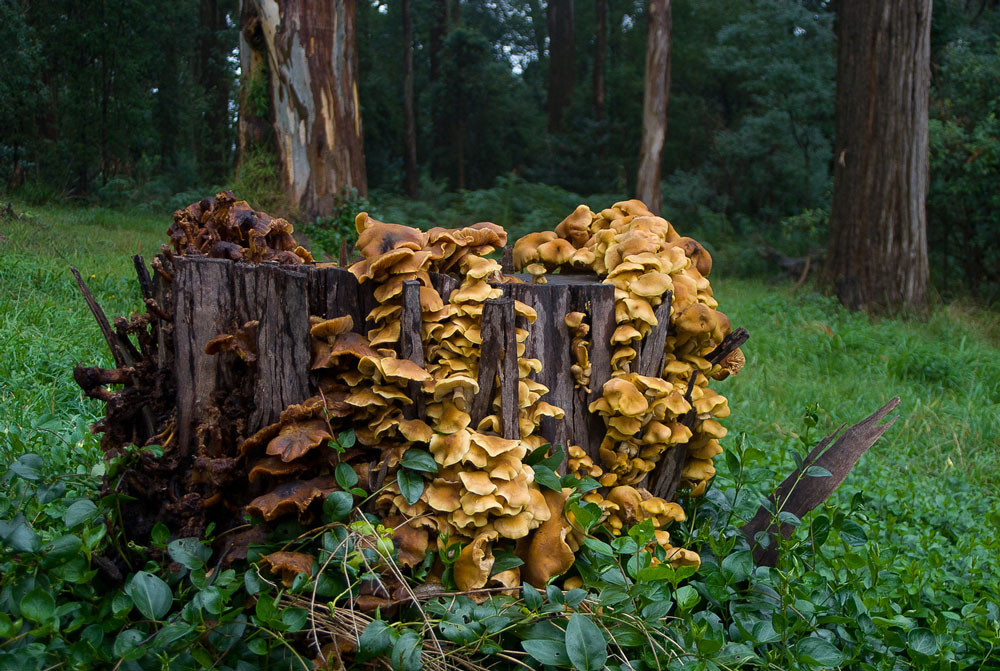
Honey fungus at the base of a tree is a warning sign of Armillaria root rot. The fungus is the visible part; the damage is in the roots.
Not sure which one your tree has?
Send us three photos: the whole tree, the base of the trunk, and a close-up of the problem. We'll tell you whether it needs a site visit, how urgent it is, and what it's likely to involve.
Send Photos Now → or call 02 4003 4400
How our tree doctor appointment works
Most of the "tree doctors" on directory sites send a crew to quote on cutting. We start with a diagnosis.
1
History & triage
We ask what's changed: recent building work, drainage, weather events, fertiliser or herbicide use, when you first noticed symptoms. We also triage your photos so urgent cases are seen first.
2
On-site diagnosis
A Visual Tree Assessment of the crown, stems, unions and root collar. We sound the trunk for hidden decay, probe the soil for compaction and moisture, and identify pests, fungi and the pattern of decline.
3
Prognosis & options
You get a clear answer: is the tree recoverable, is it safe in the meantime, and what each option costs. That includes treatment, risk-reduction pruning, monitoring or removal.
4
Treatment & follow-up
We carry out the work and book a re-check. Trees respond slowly. Recovery is judged over seasons, not weeks.
When a sample needs laboratory confirmation, for example to tell one root pathogen from another, we can help you collect and send it to an accredited plant health laboratory such as the NSW DPI plant health diagnostic service. Guessing at a pathogen and spraying is how money gets wasted.
Tree treatments we use
Every treatment is matched to a diagnosis. There's no "tonic" sold to every customer.
Root zone remediation
Relieving compaction, correcting grade changes, improving drainage, removing soil piled against the trunk, and mulching the root zone to rebuild soil biology. This is the most underrated treatment in arboriculture.
Remedial pruning to AS 4373
Removing dead, diseased and crossing wood with correct cuts at the branch collar, so the tree can compartmentalise decay. No lopping, no flush cuts, no stubs. See our dead wooding and
tree pruning services.
Targeted pest & disease control
Chosen for the specific pest or pathogen confirmed, with attention to timing, bees, pets and neighbours. Where a systemic treatment is warranted, we tell you why, and what results are realistic.
Weight reduction & risk management
If decay has weakened a limb or union, reducing end-weight can buy a valuable tree years of safe life. This is often paired with a
hazardous tree assessment.
Monitoring & management plans
For strata, schools and properties with several significant trees, we set up scheduled inspections and records.
Safe removal, when it's the right call
Newcastle trees we diagnose most often
Local knowledge matters because each species shows stress differently:
- Spotted gums and other eucalypts (Lambton, New Lambton, Charlestown, Kotara): epicormic shoots and psyllids usually point to an earlier stress event. Sudden limb drop in hot weather is a known risk with large gums.
- Jacarandas (Cooks Hill, Merewether, The Junction): bare in late winter doesn't mean dead. Scratch-test the twigs before you panic.
- Cypress and conifer hedges (Cardiff, Warners Bay, Belmont): browning patterns tell us whether it's canker, root disease or simple drought.
- Moreton Bay and Port Jackson figs: a green canopy can hide butt decay and included bark at the unions.
- Lilly pillies, bottlebrushes and paperbarks: often affected by myrtle rust, scale and waterlogging on low-lying, lake-side blocks around Swansea, Belmont and Toronto.
- Olives, citrus and fruit trees: often over-pruned by a neighbour or a cheap lopper, and they respond well to correct remedial pruning and root zone care.
Want to check for yourself first? Read our guide to signs a tree is dead or dying.
★★★★★
"I'm so happy with the prompt service and fabulous advice this company gave me to help my tree recover after my olive tree was badly hacked back by a neighbour. It's so nice to have someone who not only does a fantastic job but also takes care and pride in what they do."
Lesly Tinson, December 2023
Tree doctor vs tree lopper: what you're actually paying for
Cutting Edge tree doctor
Typical lopper
Starts with
Diagnosis of the cause
A price to cut
Qualification
AQF Level 5 consulting arborist
Often none
Pruning standard
AS 4373-2007 Pruning of Amenity Trees
Topping and lopping, which creates decay and weak regrowth
Council paperwork
Can provide supporting arborist reports
Usually can't
Outcome
Tree saved where possible, removed safely where not
Symptom removed, problem often back in 2–3 years
More on this in our guide: Arborist vs tree lopper in NSW.
Who calls a tree doctor?
- Homeowners with a much-loved tree that's suddenly looking sick
- Strata committees and property managers who need documented duty-of-care decisions
- Schools, churches and commercial sites with significant trees near people
- Buyers and builders who need to know whether a tree will survive a renovation, or need an arborist report for council
We cover all of Newcastle and the Hunter, including Lake Macquarie, Maitland, Port Stephens, Cessnock the Mid Coast & Great Lakes, and the Hunter Valley.
Tree doctor FAQs
Can a sick tree really be saved?
Often, yes, if the cause is found early and it can be fixed: compaction, drainage, a pest outbreak on a stressed tree, or poor past pruning. Trees with advanced root rot or major structural decay may not be recoverable, or may not be safe to keep. A diagnosis tells you which situation you're in before you spend money on either option.
How long does it take a tree to recover?
Expect to judge progress over one to two growing seasons. Healthy new extension growth, a fuller crown and normal leaf size are good signs. Epicormic shoots sprouting from the trunk on their own aren't proof of recovery. They're often a stress response.
Is a tree with fungus on it dangerous?
Not always, but it always needs checking. Some fungi are harmless decomposers in mulch. Others, like Ganoderma or Armillaria at the trunk base, signal decay in the structural roots or butt, which can lead to whole-tree failure. Don't remove the fungus. Photograph it and call us.
Do I need council approval to treat or prune a sick tree?
Treatment and minor pruning carried out to AS 4373 by a suitably qualified arborist usually don't need a permit in Newcastle. Removal or major pruning of a protected tree generally does, although dead trees and immediate hazards have specific exemptions. See our
tree removal permits guide.
How much does a tree doctor visit cost?
It depends on the number of trees, how complex the problem is, and whether you need a verbal assessment or a written report. Send photos first. In many cases we can tell you over the phone whether a visit is worthwhile, and what the next step is likely to cost, before you commit to anything.
My neighbour's tree is sick and dropping branches. What can I do?
Start with a conversation, ideally backed by an independent arborist's opinion. If that doesn't resolve it, NSW has a legal process for tree disputes between neighbours. An arborist report gives you solid evidence either way.
The sooner it's diagnosed, the more options you have
Tree decline is easiest and cheapest to treat early. Every month you wait narrows your options and raises the risk. Talk to a qualified Newcastle tree doctor today.
AQF Level 5 consulting arborist · $20M public liability · Servicing the Hunter since 2015 · ABN 77 641 795 155
About this page: Written by the Cutting Edge Tree Maintenance arborist team and reviewed by our AQF Level 5 consulting arborist. It reflects our field experience across Newcastle, Lake Macquarie and the Hunter, and current Australian pruning standards (AS 4373-2007). Updated October 2026.
Meet our team.