Tree Risk Assessments for Schools, Strata and Commercial Properties in Newcastle
Tree risk assessments help schools, strata managers and commercial property owners identify hazardous trees before they cause injury, property damage or operational disruption. A qualified arborist assesses the tree, the defect, the surrounding targets, and the site conditions before recommending practical controls such as pruning, deadwooding, monitoring, exclusion zones, tree removal, or a longer-term tree management plan.
Managing trees on a high-use site is different from looking after one tree in a backyard. A school, childcare centre, strata complex, commercial property, car park, industrial yard or shared access road has more people moving through the target zone every day. That changes the risk profile.
At Cutting Edge Tree Maintenance, we provide hazardous tree assessments, arborist services, tree pruning, tree removal and tree management plans across Newcastle, Lake Macquarie, Port Stephens and the Hunter.
Why Tree Risk Assessments Matter on High-Use Sites

A tree becomes a risk when there is a likelihood of failure and a target that could be harmed. The target might be a child walking under a limb, a parked car, a classroom, a driveway, a footpath, a boundary fence, a loading bay, a roofline, a playground or a common-property courtyard.
That is why schools, strata complexes and commercial sites need more than a quick "does the tree look okay?" inspection. A dead branch over a rarely used garden bed may be a low priority. The same branch over a school pick-up zone, childcare play area, strata pathway or commercial car park may need faster action.
Tree risk is not just about the tree. It is about the tree, the defect, the weather exposure, the site use and what would be hit if the tree or limb failed.
Who Should Arrange a Tree Risk Assessment?
A tree risk assessment is useful for any property where trees are close to people, buildings, access routes or assets. It is especially important for:
- School principals, business managers and maintenance coordinators
- Childcare centres and early learning facilities
- Strata managers and owners corporations
- Commercial property managers
- Industrial sites and warehouses
- Aged care facilities and community properties
- Churches, halls and private institutions
- Car parks, shared driveways and high-traffic pedestrian areas
- Sites with large gums, spotted gums, blackbutts, paperbarks, casuarinas, palms, figs or older ornamental trees
If you manage a property and cannot clearly answer when the trees were last inspected, which trees are high priority, which limbs need attention and what work has been recommended, it is time to book a professional inspection.
What Makes Tree Risk Different in Newcastle and Lake Macquarie?
Tree risk in Newcastle and Lake Macquarie is shaped by local site conditions. A tree in a sheltered courtyard in Hamilton is different from a coastal tree in Merewether, a lakeside tree in Warners Bay, a large eucalypt near a Cardiff warehouse, or a paperbark in low-lying ground around Swansea or Belmont.
In Newcastle, tree risk assessments often involve older established suburbs such as Cooks Hill, The Junction, Hamilton, New Lambton, Lambton, Mayfield, Waratah, Adamstown, Kotara and Merewether. These sites may have older ornamental trees, large retained eucalypts, narrow access, heritage streetscapes, boundary issues and buildings close to the root zone.
In Lake Macquarie, tree risk assessments often involve Warners Bay, Charlestown, Cardiff, Belmont, Valentine, Eleebana, Mount Hutton, Toronto, Swansea, Speers Point and Edgeworth. These properties may include larger blocks, strata complexes, lake-influenced wind exposure, sloping ground, drainage issues, older gums, casuarinas, paperbarks and trees growing close to driveways, pools, retaining walls and shared access areas.
The important point is that local tree risk is not just about whether a tree looks big or old. It is about species, structure, exposure, soil conditions, defects, target occupancy, council rules and what would happen if a limb or tree failed.
Newcastle Council and Lake Macquarie Council Tree Requirements
Tree risk assessments in Newcastle and Lake Macquarie should always consider the relevant council area. A tree that may be exempt in one situation may still require approval, documentation or further arborist advice in another.
In the City of Newcastle area, private tree work must be considered against council’s Urban Forest Technical Manual. Some trees may be exempt from approval, including certain storm-damaged or dangerous trees, trees below specified size thresholds, trees close to certain structures, or listed exempt species. However, exemptions can be limited by heritage, habitat, Aboriginal heritage, native vegetation, wetlands and other site constraints.
If a tree in Newcastle is suddenly damaged by a storm or strong winds and poses an immediate risk to life or property, urgent removal may be possible, but the council still requires the correct storm-damaged tree removal form to be submitted within the required timeframe after removal. For non-exempt tree removal, the council may require a Level 5 Arborist Report explaining the tree's condition, defects and reason for removal.
In Lake Macquarie, property owners should be especially careful with native trees and Araucaria pines. Lake Macquarie Council says a Tree Application may be required before pruning or removing a native tree or Araucaria Pine species from private property.
For schools, strata managers and commercial property owners, the safest approach is to confirm whether the tree is in Newcastle LGA or Lake Macquarie LGA before arranging major pruning or removal. If the tree is native, large, structurally defective, close to buildings, storm-damaged, part of a development site, in a heritage area, or near sensitive vegetation, get arboricultural advice before works begin.
For council-related information, see our guide to tree removal permits in Newcastle and Lake Macquarie.
Before arranging major pruning or tree removal, property managers should check the relevant council rules:
City of Newcastle private tree removal guidance explains that the Urban Forest Technical Manual must be followed and that storm-damaged tree removal documentation may still be required, while Lake Macquarie Council tree pruning and removal guidance notes that a Tree Application may be required before pruning or removing native trees or Araucaria Pine species.
Local Trees Commonly Assessed Around Newcastle and Lake Macquarie
An experienced local arborist does not assess every species the same way. Different trees have different growth habits, defect patterns and site risks.
Spotted Gum
Spotted gums are common across parts of the Hunter and Lake Macquarie landscape. On commercial, strata and school sites, the assessment often focuses on long lateral limbs, deadwood, co-dominant stems, old pruning wounds, branch attachment and the target area below the canopy. A spotted gum over a car park or playground needs a different risk approach from one growing over a low-use garden bed.
Blackbutt
Blackbutt is a significant native tree in the Newcastle and Lake Macquarie region. They can provide excellent canopy and habitat value, but mature trees near buildings, roads, playgrounds, or common property may need careful inspection for deadwood, past storm damage, decay, root zone disturbance, and the risk of branch failure.
Paperbarks and Melaleucas
Paperbarks are often found around wetter areas, drainage lines and low-lying sites. Around lakeside suburbs and damp areas, an arborist may closely examine root conditions, soil saturation, trunk defects, canopy dieback, and the stability of trees growing near paths, car parks, or structures.
Casuarinas and Swamp Oaks
Casuarinas and swamp oaks are common near coastal, lake and drainage environments. In a tree risk assessment, the arborist may consider deadwood, root plate stability, soil moisture, branch shedding, wind exposure and proximity to paths, fences, roads or shared access areas.
Eucalypts and Gum Trees
Many Newcastle and Lake Macquarie risk assessments involve gum trees. These may include large native eucalypts in school grounds, strata common areas, commercial boundaries and bushland-edge properties. The assessment may focus on deadwood, including bark, long heavy limbs, canopy imbalance, old lopping wounds, cavities, fungal activity and whether the tree has adequate root space.
Palms
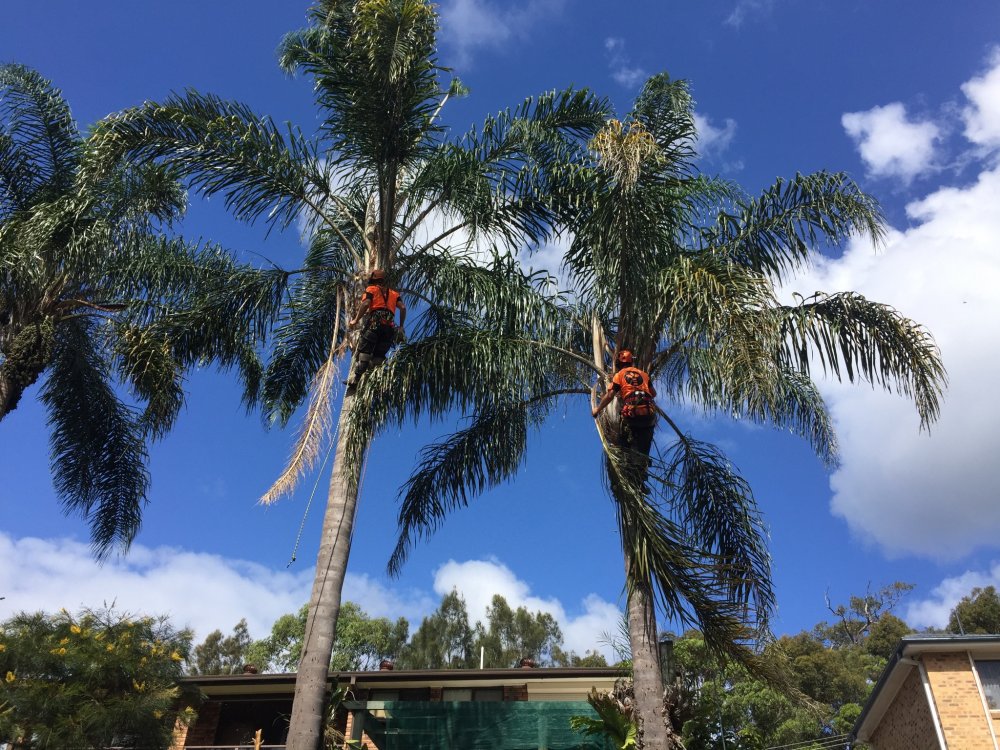
Palms need to be assessed differently from woody trees. Around pools, apartment complexes, and commercial sites, the concerns may include dead fronds, fruit drop, trunk defects, root disturbance, access limitations, or palm removal requirements.
Figs and Large Ornamental Trees
Older suburbs such as Cooks Hill, Hamilton, The Junction, New Lambton and parts of Newcastle may contain larger ornamental trees and figs. These trees can have high amenity value but may also affect paving, pipes, walls, driveways and building clearances. The goal is to manage risk without unnecessarily removing valuable canopy.
What an Arborist Looks for During a Tree Risk Assessment
A proper tree risk assessment is not a quick glance from the driveway. An experienced arborist reads the tree from the ground up, then relates its condition to the surrounding site.
On a school, strata or commercial site, an arborist may consider:
- Tree species and known failure patterns
- Age class, vigour and vitality
- Canopy density, dieback and epicormic growth
- Deadwood size, position and target exposure
- Included bark and weak branch unions
- Co-dominant stems and compression forks
- Previous lopping wounds and decay columns
- Fungal fruiting bodies around the trunk, buttress roots or root zone
- Cavities, hollows and habitat features
- Cracks, ribs, seams, bulges and adaptive growth
- Root plate movement, soil heave or recent change in lean
- Compaction from vehicles, foot traffic or construction
- Changes to drainage, soil level or hard surfaces
- Clearance from buildings, roofs, gutters, paths and fences
- Proximity to playgrounds, car parks, roads and gathering areas
- Overhead services and nearby underground utilities
- Whether pruning, exclusion, monitoring or removal is the most practical control
One of the most useful arborist skills is knowing the difference between a visible defect and a meaningful risk. Not every hollow tree is dangerous. Not every leaning tree is unstable. Not every dead branch requires the whole tree to be removed. The assessment needs to consider the likelihood of failure, the likelihood of impact and the consequence.
Important Arborist Terms for Property Managers
Target zone - The area where a tree or branch could land if it failed. On a school, strata, or commercial site, the target zone might include a playground, car park, roof, footpath, entrance, driveway, outdoor seating area, or a neighbouring property.
Target occupancy - How often people, vehicles or assets are present in the target zone. A defect on a heavily used walkway usually needs more attention than the same defect on an unused garden bed.
Likelihood of failure - The chance that a tree, stem or limb may fail within a relevant timeframe. This is influenced by species, structure, defect severity, decay, wind loading, past pruning damage and site conditions.
Likelihood of impact - The chance that a failed tree part would strike a person, vehicle, building or other target. A limb can fail without causing harm if there is no target below it.
Consequence - The likely severity of harm or damage if the tree or branch fails and impacts the target. A limb over a garden bed has a different consequence profile from a limb over a school play area or car park.
Defect loading - The stress placed on a weak point in the tree. Long, end-weighted limbs, wind exposure, and included bark and decay can increase the load on a branch union or stem.
Adaptive growth - Extra wood laid down by the tree in response to stress, weakness or movement. Adaptive growth can show that the tree is responding to a defect, but it still needs interpretation by an arborist.
Root plate stability - The ability of the tree's root system and surrounding soil to hold the tree upright. Saturated soil, excavation, root cutting, compaction and decay can all affect root plate stability.
Residual risk - The level of risk remaining after recommended works are completed. For example, pruning may reduce the risk from a defective limb, but ongoing monitoring may still be recommended.
Mitigation - The action recommended to reduce risk. Mitigation may include dead-wooding, formative pruning, weight reduction, canopy clearance, exclusion zones, target relocation, monitoring, or tree removal.
Visual Tree Assessment vs Advanced Inspection
Most tree risk assessments begin with a ground-based visual inspection. This is often enough to identify obvious defects, prioritise work and recommend practical next steps.
Some trees need a more detailed assessment. This may be the case if the tree is large, high-value, protected, close to buildings, located in a high-use area or showing signs of internal decay, root damage or structural instability.
The right level of assessment depends on the tree, the site and the decision being made. A single backyard tree may only require a basic inspection. A school, strata complex or commercial site with multiple trees may benefit from a formal tree inventory and prioritised risk register.
What Should Be Included in a Tree Risk Assessment Report?
A useful report should be clear enough for a non-arborist to understand, but detailed enough to support decisions. For schools, strata committees, and commercial property managers, the report should explain the observations, the risk context, and the recommended action.
A strong tree risk assessment report may include:
- Site address and inspection date
- Whether the site is in Newcastle LGA or Lake Macquarie LGA
- Tree number, species and location on the site
- Approximate height, canopy spread and diameter at breast height
- Tree health and structural condition
- Photos showing the whole tree and specific defects
- Target zone, such as playground, car park, building, driveway, path, fence or neighbouring property
- Evidence of defects such as included bark, deadwood, decay, cavities, fungal brackets, root plate movement, storm damage or old lopping wounds
- Risk rating or priority category
- Recommended works, such as pruning, dead wooding, monitoring, exclusion, target relocation or removal
- Whether the works may require council approval
- Whether a Level 5 Arborist Report is recommended
- Suggested timeframe for works
- Recommended reinspection interval
For larger sites, a tree risk register is often more useful than a long narrative report. A register allows a property manager to track each tree, its current condition, the recommended action and the priority timeframe.
Risk Categories: Not Every Tree Needs Immediate Removal
One of the biggest misunderstandings about tree risk assessments is that the report will automatically recommend removal. In practice, many trees can be retained with sensible mitigation.
Depending on the defect and target zone, an arborist may recommend:
- No work required at this stage
- Reinspection after storm season or within a set timeframe
- Dead wooding over paths, playgrounds or car spaces
- Canopy reduction to reduce end weight
- Clearance pruning away from roofs, gutters or access routes
- Removing a specific failed or defective limb
- Restricting access below a high-risk tree until work is completed
- Moving the target, such as relocating seating, bins or car spaces
- Tree removal where there is no practical way to reduce risk
This is especially important for schools and strata properties, where trees may provide shade, privacy, habitat and amenity value. A good arborist does not remove trees without reason. The aim is to manage risk while keeping healthy, suitable trees where possible.
For more on how arborists decide between removal and retention, read our guide to tree removal vs pruning.
Tree Risk Assessments for Strata Properties
Strata sites often have trees in common areas, courtyards, driveways, boundary zones, garden beds and shared access paths. The challenge is that residents may have different opinions. One owner may want a tree removed for sunlight or views, while another values privacy and shade.
A professional tree risk assessment moves the discussion from opinion to evidence. It documents the tree's condition, risk level and recommended action. This helps strata committees, owners' corporations and managers make fair, defensible decisions.
Common strata tree issues include:
- Branches over roofs, gutters and balconies
- Roots affecting paving, pipes or retaining walls
- Leaf and fruit drop in shared areas
- Visibility and access issues near driveways
- Neighbouring tree disputes
- Deadwood over car spaces or walkways
- Protected trees requiring council documentation
For strata-specific assistance, see our strata tree services.
Why Use a Qualified Arborist Instead of a General Contractor?
Tree risk assessment is not just tree cutting. It requires an understanding of tree biology, structure, decay, load, root systems, species behaviour, site use and practical mitigation options.
A general contractor may be able to remove branches, but an arborist can explain whether the work is necessary, whether it will reduce risk, whether it may damage the tree, whether removal is justified and whether a report may be needed.
For schools, strata, and commercial properties, this matters because decisions may later need to be explained to owners, insurers, the council, tenants, parents, or asset managers.
Cutting Edge Tree Maintenance provides practical arboricultural advice, tree pruning, hazardous tree assessment, tree removal, and stump grinding across Newcastle and the surrounding areas.
Book a Tree Risk Assessment in Newcastle or Lake Macquarie
If you manage a school, childcare centre, strata complex, commercial property, car park, shared access area or high-use site in Newcastle or Lake Macquarie, a tree risk assessment can help you make safer and better-documented decisions.
Cutting Edge Tree Maintenance can inspect trees across Newcastle suburbs such as Cooks Hill, Hamilton, Merewether, New Lambton, Lambton, Mayfield, Waratah, Adamstown and Kotara, as well as Lake Macquarie areas such as Warners Bay, Charlestown, Cardiff, Belmont, Valentine, Eleebana, Toronto, Swansea and Mount Hutton.
We can assess tree defects, explain the risks in plain language, and recommend practical next steps such as pruning, deadwooding, monitoring, tree removal, access control, stump grinding, or an ongoing tree management plan.
Contact Cutting Edge Tree Maintenance to arrange a tree risk assessment in Newcastle, Lake Macquarie, Port Stephens or the Hunter.
Tree Risk Assessment FAQs
What is a tree risk assessment?
A tree risk assessment is an arborist inspection that considers the likelihood of a tree or limb failing, the likelihood of it impacting a target, and the possible consequences. On school, strata and commercial sites in Newcastle and Lake Macquarie, the target may be a playground, car park, building, shared driveway, pedestrian path, fence, roof, loading zone or neighbouring property.
Do schools in Newcastle and Lake Macquarie need tree risk assessments?
Schools should have a clear system for managing trees, especially in high-use areas such as playgrounds, pick-up zones, outdoor learning areas, covered walkways and assembly areas. A professional arborist assessment helps identify hazards, prioritise work, and document recommended actions before a tree or limb failure causes harm or disruption.
Do strata properties need council approval to remove a tree?
They may. In Newcastle and Lake Macquarie, tree removal can be affected by tree size, species, condition, native vegetation controls, heritage considerations, habitat value and council requirements. Strata managers should seek arboricultural advice before arranging major pruning or removal, especially where the tree is native, large, structurally defective, or located in a shared area.
What trees are commonly assessed around Newcastle and Lake Macquarie?
Common trees assessed in the region include eucalypts, spotted gums, blackbutts, paperbarks, casuarinas, palms, figs and large ornamental trees. The risk issues vary by species and site. A large gum over a school playground, a paperbark in wet ground near a path, or a spotted gum over a commercial car park each requires a different assessment approach.
How often should school, strata and commercial trees be inspected?
The inspection interval depends on the site, tree species, condition, target occupancy and exposure. Trees over playgrounds, car parks, building entrances, shared pathways and loading zones may need more regular monitoring than trees in low-use garden areas. Trees should also be checked after storms, sudden limb failure, excavation, construction or visible movement.
Does a tree risk assessment always recommend removal?
No. Many trees can be retained through pruning, deadwooding, weight reduction, target management, or monitoring. Removal is usually recommended when the tree presents an unacceptable risk that cannot be reasonably reduced by other methods, or when the tree is dead, structurally unsound, severely storm-damaged or causing serious damage.
What should I do if a tree looks dangerous after a storm?
Keep people and vehicles away from the target zone and contact a qualified arborist. Do not try to cut unstable limbs or storm-damaged trees yourself, especially near buildings, fences, roads, or power lines. In Newcastle, storm-damaged or dangerous tree removal may still require documentation after urgent works, so photos and arborist notes are important.