When Is Removing a Large Gum Tree in Newcastle the Only Safe Option?
Large gum trees are a defining feature of many Newcastle properties. They provide shade, habitat, and visual appeal, but when they grow close to homes, driveways, or neighbouring structures, they can also present serious and sometimes underestimated safety risks.
While many homeowners assume a healthy-looking tree is safe, arborists assess risk very differently. In some situations, removing a large gum tree is the only responsible option to prevent injury or property damage, even if the tree appears outwardly sound.
This guide explains when removal becomes the safest choice, the warning signs arborists look for, and how these decisions are made in real-world Newcastle conditions.
A clear answer for homeowners
Removing a large gum tree is the safest option when the likelihood of failure and its consequences cannot be reduced to an acceptable level through proper pruning, treatment, or monitoring.
This commonly applies when:
-
Structural defects are present in the trunk or root system
-
Large limbs extend over homes or high-use areas
-
Repeated branch failures have occurred
-
Storm damage has compromised stability
-
The tree's location makes long-term risk management impractical
A tree does not need to fall to be considered unsafe. Risk is assessed based on what could happen, not just what has already happened.
Why large gum trees require careful risk assessment
Gum trees, or eucalypts, are fast-growing native species that can reach heights exceeding 30 metres. As they mature, their size alone creates significant mechanical stress on trunks, branches, and root systems.
According to arboricultural research and industry data, tree size is one of the strongest predictors of potential damage during failure, simply due to mass and momentum. Large limbs carry enormous weight, and when failure occurs near buildings or people, consequences are often severe.
Studies cited by arboricultural associations indicate that structural failures are more common in large, mature trees, particularly when decay, previous pruning wounds, or soil disturbance are present.
The larger the tree, the smaller the margin for error when defects develop.
Another recognised concern with mature gum trees is the risk of unpredictable limb failure. While not universal, arborists acknowledge that large lateral limbs can fail without obvious external warning, particularly during heat stress, drought recovery, or high winds.
When these risks coincide with nearby targets such as homes, driveways, play equipment, or public areas, risk escalates quickly.
Key warning signs that removal may be the only safe option
Structural defects at the trunk or base
Structural defects significantly increase the likelihood of failure.
Common high-risk indicators include:
-
Large vertical cracks or splits in the trunk
-
Advanced decay or hollowing at the base or major branch unions
-
Leaning trees with soil heave or root plate movement
-
Fungal growth associated with internal decay
These defects often require a hazardous tree assessment to determine whether the tree can be safely retained or removed.
Once structural integrity is compromised, pruning alone cannot restore strength.
Dangerous limbs and canopy failures
Canopy-related failures are one of the most common reasons large gum trees are removed.
Warning signs include:
-
Large dead limbs suspended over roofs or driveways
-
Multiple limb failures over time from the same tree
-
Heavy lateral branches extending well beyond the trunk
-
Extensive dead wood throughout the canopy
Industry guidance consistently shows that repeated limb failure is a strong predictor of future failures. If removing hazardous limbs would leave the tree structurally imbalanced or unhealthy, removal is often the safer long-term solution.
Site conditions that increase consequences
Risk is not just about the tree. It is also about what the tree can hit.
High-risk site conditions include:
-
Trees directly over houses, sheds, or garages
-
Overhang above driveways, footpaths, or play areas
-
Limited drop zones that restrict safe pruning or rigging
-
Exposure to strong coastal winds or storm corridors
In these environments, even a low likelihood of failure can be unacceptable due to the severity of potential outcomes.
A low-probability event can still be unacceptable if the consequences are severe.
How Arborists Decide Whether Removal Is Necessary
Professional arborists use a risk-based decision process rather than relying on tree appearance or age alone.
Assessments typically consider:
-
Likelihood of failure based on defects and conditions
-
Targets that could be impacted
-
Severity of consequences if failure occurs
-
Whether pruning or treatment can reasonably reduce risk
If risk remains unacceptably high after considering all management options, removal is recommended to prevent foreseeable harm.
For complex or high-risk cases, a formal hazardous tree assessment provides documented reasoning and clear recommendations.
Pruning, lopping, or removal. Understanding the difference
Proper pruning aims to improve structure, health, and safety while preserving the tree. Lopping removes large portions of the canopy without regard for long-term stability and is widely regarded as an unsafe practice.
For large gum trees with serious defects, heavy pruning can actually increase risk by:
-
Creating large wounds that encourage decay
-
Shifting load onto weaker branches
-
Stimulating weak regrowth
Poor pruning can accelerate decline and increase the likelihood of failure.
When compliant pruning cannot reduce risk to an acceptable level, removal becomes the responsible option.
Council approval and large gum trees
Large gum trees are often native species and may be subject to council controls depending on location, condition, and circumstances.
In Newcastle and surrounding areas, approval may be required unless an exemption applies to dead or dangerous trees. Understanding these requirements early prevents delays and compliance issues. For specific council requirements in Newcastle, the City of Newcastle's official tree removal guidance outlines when approval is required and the documentation that may be required.
Homeowners unsure about approval requirements should review local guidance or seek advice before proceeding. Read our guide to tree removal permits in Newcastle for expert insights.
How the removal method affects the cost for large gum trees
Removing a large gum tree is labour-intensive and technically demanding. Cost is influenced by factors such as:
-
Tree height and canopy spread
-
Proximity to buildings and services
-
Need for controlled dismantling or advanced rigging
-
Crane or elevated equipment requirements
-
Green waste volume and disposal
-
Stump grinding requirements
Industry pricing data shows that large tree removals can cost several times more than smaller removals, particularly where access is limited or risk is high.
For budgeting guidance, see our overview of tree removal costs in Newcastle, based on average estimates rather than fixed prices.
When immediate danger exists, emergency tree removal may be required to mitigate the risk.
What to do if you are concerned about a large gum tree
If you believe a large gum tree on your property may be unsafe:
-
Restrict access to the potential fall zone
-
Photograph the trunk, base, canopy, and nearby structures
-
Arrange a professional hazardous tree assessment
-
Confirm council requirements if applicable
-
Request a detailed quote with a clear scope of work
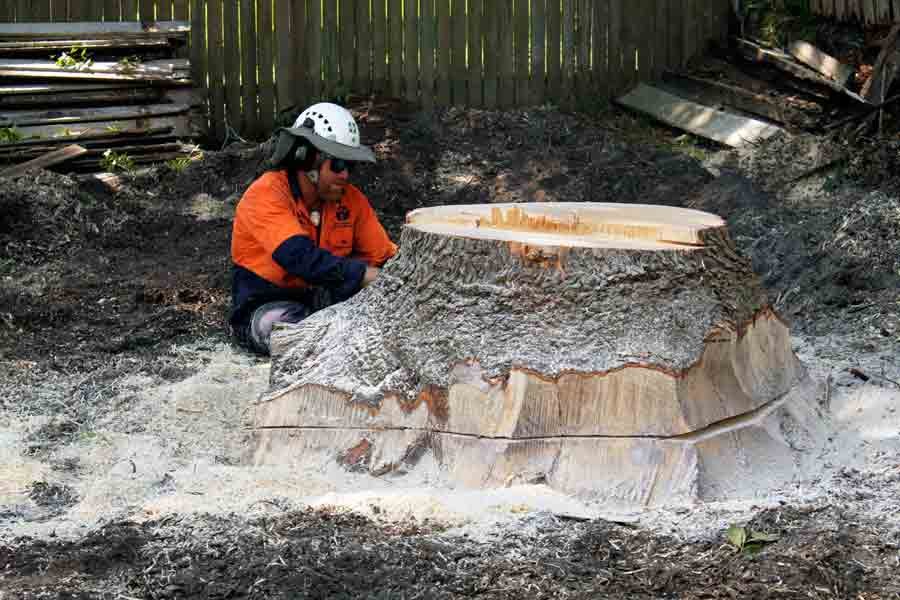
For situations requiring removal, choosing an experienced provider for tree removal in Newcastle ensures the work is carried out safely and in compliance.
Frequently asked questions
Can a healthy-looking gum tree still be dangerous?
Yes. Internal decay and structural defects are not always visible to the naked eye, which is why professional assessment is important.
Is pruning always safer than removal?
No. In some cases, pruning cannot reduce risk sufficiently and may increase instability.
Are large gum trees more likely to cause damage if they fail?
Yes. Due to their size and mass, failures involving large gum trees typically result in greater damage.
Do all large gum trees need council approval for removal?
Not always. Requirements vary by location and condition, but this should always be checked.
So, Are You Ready?
Large gum trees deserve respect, not fear. Many can be managed safely with proper care, but some reach a point where removal is the only responsible option.
When risk to people or property becomes unacceptable, removal is not about convenience or preference. It is about prevention, safety, and sound judgment based on professional assessment.
If you are unsure, a qualified arborist can provide clarity and help you make the safest decision for your property.