Is My Tree Dead or Dying? Signs Newcastle Homeowners Should Look For
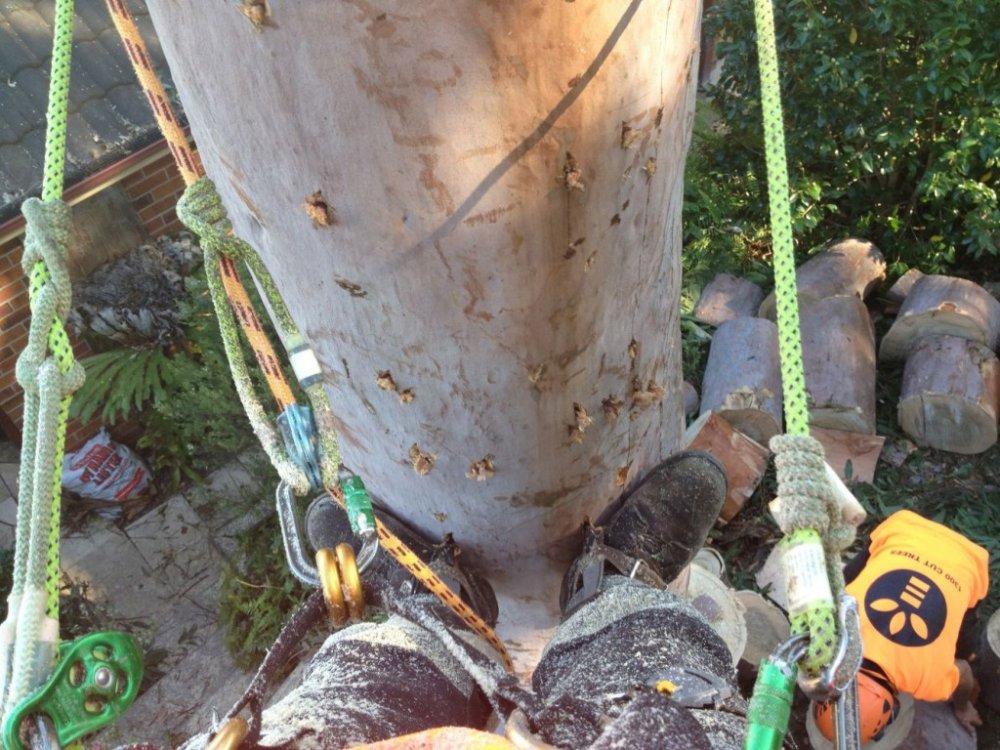
Dead, dying or stressed?
A dead tree has ceased biological function. A dying tree is still alive but is showing progressive loss of vigour, growth or canopy function. A stressed tree may look poor temporarily and recover. Arborists distinguish between them by looking at the pattern of decline across the crown, trunk and root zone, how quickly it is changing and whether the tree is still responding.
A spotted gum develops a thinner crown. A jacaranda stays bare longer than expected. Dead tips appear high in a eucalypt. A Norfolk Island pine develops brown branch ends.
Those observations matter, but they are not diagnoses.
A declining tree is better read as a timeline than as a photograph. What has changed, where did the change begin, and is the tree recovering or continuing to decline?
A dying tree may be showing an older problem
Canopy decline can appear long after the original stress. Roots may have been cut during trenching, soil compacted during building work, drainage altered or more of the root zone covered by paving.
What recent Australian research tells us
Australian research following the extreme 2019 to 2020 summer found substantial canopy dieback and reduced growth in urban trees. Trees with severe dieback recovered more slowly, while smaller trees surrounded by high levels of hard surface were particularly vulnerable to drought stress. The canopy can therefore be showing a root-zone, water or heat problem that began well before the leaves disappeared.
A sparse crown may reflect hydraulic stress, restricted root volume, compaction, excavation damage, excessive moisture, heat, disease or several factors acting together.
The canopy may be the messenger, not the cause
When a crown starts thinning, also look down. Has a driveway been widened? Was a trench dug for drainage, power or telecommunications? Has the soil level changed? Is water now running away from the roots, or sitting around them?
Different Newcastle trees show stress differently
Species matters. A symptom that is normal for one tree can be significant in another.
Jacaranda: bare does not necessarily mean dead
Jacaranda (Jacaranda mimosifolia) is deciduous. A bare tree should be assessed against season, bud development and twig condition rather than compared with an evergreen tree beside it.
Conifers: look at the pattern of browning
One branch dying back from a canker means something different from an entire crown losing density. Newcastle's disease guidance also records Botryosphaeria dieback on Norfolk and Cook Island pines, particularly where trees are already stressed.
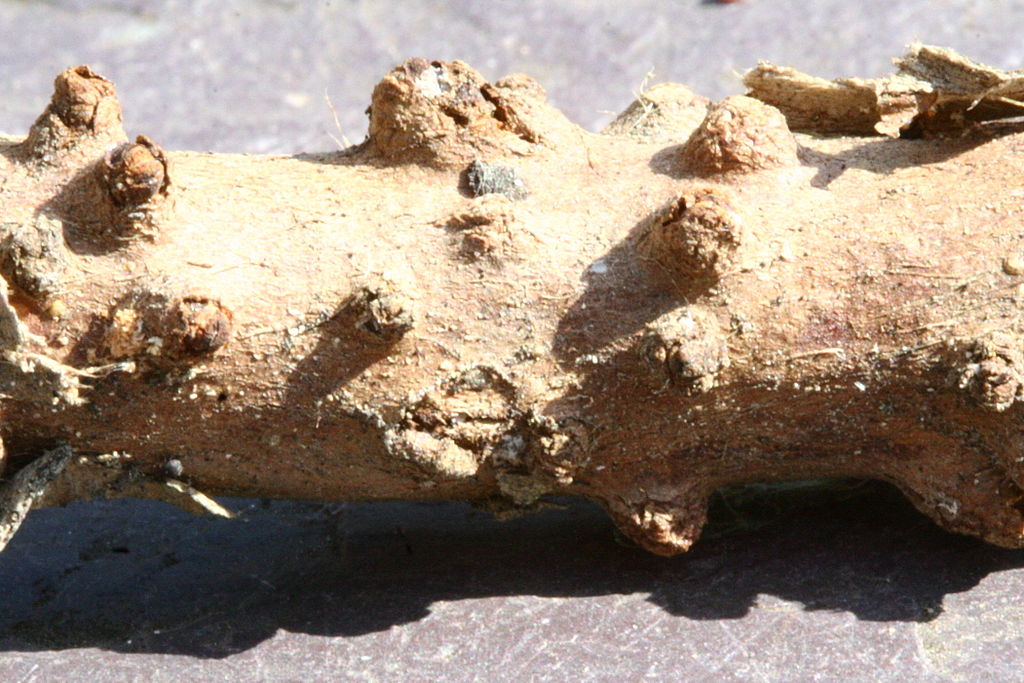
Localised branch dieback can provide an important clue, but species, canopy pattern and overall vigour still need to be considered.
Spotted gums, eucalypts, paperbarks and bottlebrushes: inspect the new growth
Myrtle rust attacks young foliage and shoot tips in the Myrtaceae family, including Eucalyptus, Corymbia, Melaleuca, Callistemon and Syzygium. Repeated damage to new growth can progressively reduce canopy function in susceptible trees.
Moreton Bay figs: a green crown does not tell the whole story
Mature Moreton Bay figs (Ficus macrophylla) can retain substantial foliage even where defects occur around the lower stem or structural roots. Their buttresses, root flare, cavities and site history can be more informative than foliage colour alone.
What are the strongest signs that a tree is dying?
The strongest evidence is usually progressive change affecting more than one part of the tree.
Signs that carry more diagnostic weight
Progressive crown dieback: branch-tip death moving further into the crown rather than isolated dead twigs.
Reduced vigour: shorter annual shoots, smaller leaves, sparse foliage or poor recovery after stress.
Increasing deadwood: particularly larger branches or mortality spreading through the upper crown.
Crown decline plus root or stem symptoms: basal decay, cavities, fungal fruiting bodies, damaged roots, bark dysfunction or movement around the root plate.
If deadwood is the main issue but the tree remains viable, dead wooding may be more appropriate than removing the whole tree.
Why the root zone matters in Newcastle
Urban trees grow beside driveways, roads, paving, retaining walls and compacted lawns. Roots require oxygen as well as water, so both drought and prolonged saturation can cause decline.
Hard surfaces also reduce rooting space, alter rainfall infiltration and increase heat around the tree.
Compound stress matters
A eucalypt may cope with heat until root damage reduces access to water. A pathogen may become more damaging after prolonged stress. Roots weakened during excavation may not produce obvious crown symptoms until the next hot period.
This is why site history matters during tree diagnostics and treatment.
New growth on the trunk does not necessarily mean recovery
Epicormic shoots arise from dormant buds beneath the bark. In eucalypts they can help rebuild canopy after fire, storm damage or severe stress.
Arborist's view
Epicormic shoots tellmargin:0;color:#333333 !important;"> Epicormic shoots tell us that part of the tree is alive. They do not tell us why the original crown declined or whether that problem has stopped.
The fungus is not the diagnosis
Fungal fruiting bodies can be important evidence, but their meaning depends on the organism, where it is growing and the condition of the host tree.
Armillaria root rot
Armillaria can first appear as poor vigour, yellowing foliage or dieback. More useful evidence may occur around the root collar, beneath loose bark or as fruiting bodies at the tree base.
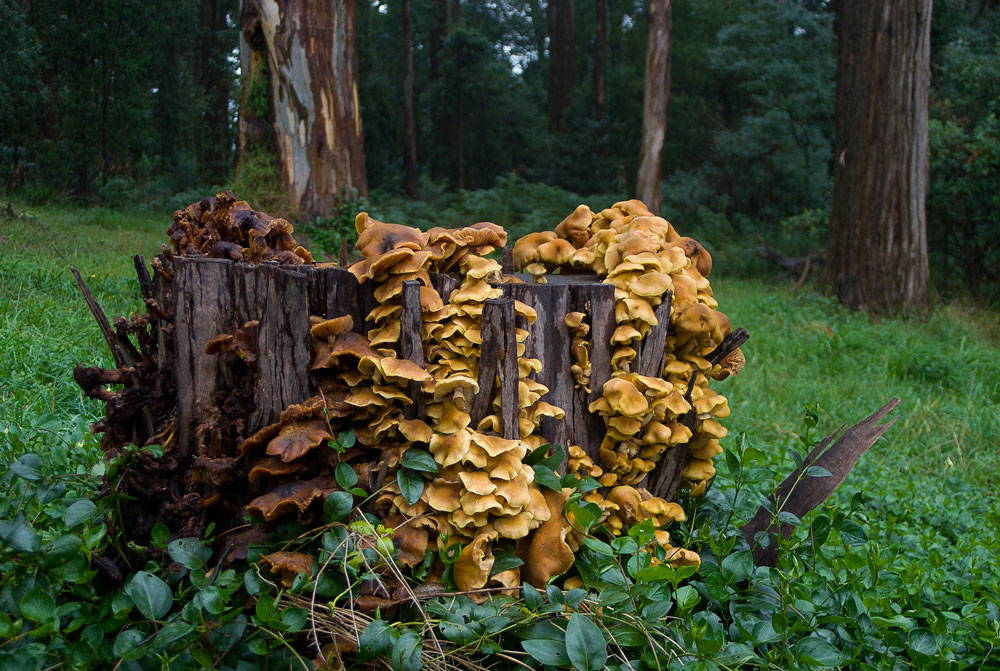
Fruiting bodies can be an important diagnostic clue, but they still need to be interpreted alongside tree vigour, root condition and the location of decay.
Ganoderma and Kretzschmaria
Ganoderma brackets can be associated with lower-stem or butt decay. Kretzschmaria deusta can affect the stem base and woody roots but may produce only small, easily overlooked dark fruiting structures. In both cases, the important question is how much structural wood remains and where the decay is located.
Phytophthora: think roots and drainage
Phytophthora cinnamomi damages fine roots and can reduce water and nutrient uptake. Root-zone moisture and drainage therefore matter when interpreting the canopy symptoms.
See City of Newcastle's Disease and Insect Pest Management Protocol or our guide to common tree diseases.
A green tree is not automatically a safe tree
Health, structural condition and risk are different questions.
A stressed tree can remain structurally serviceable. Another tree can carry a full green crown while decay has weakened the lower stem or roots.
Three questions an arborist separates
Health: How well is the tree functioning biologically?
Structure: Can the stem, branches and root system support their loads?
Risk: If something fails, what could be affected?
If structural safety is the main concern, see our Newcastle tree risk assessment guide.
Can a dying tree recover?
Sometimes. A tree described casually as "dying" may actually be stressed or declining.
Recovery may be possible where the main stress can be corrected and enough functional crown and root system remain. Options can include improving root-zone conditions, correcting water availability, pruning dead branches or treating a manageable disease.
Extensive root loss, severe vascular dysfunction, advanced basal decay or continuing canopy mortality provide a much poorer prognosis.
Recovery can take time
Australian research following severe heat and drought has shown that recovery from crown dieback can take several favourable growing seasons. The direction of change is often more useful than one season's appearance.
When does City of Newcastle consider a tree dead or dying?
City of Newcastle defines a dead tree as one where biological function has ceased, no leaves are present and there is visible evidence of desiccation in the trunk, root plate and canopy.
For a dying tree, Council documentation looks at indicators such as reduced growth, sparse foliage and reduced response to damage or stress over subsequent growing seasons.
Some qualifying dead or dying private trees can use an exemption pathway instead of the standard removal-permit process, but habitat, heritage and other controls still matter.
City of Newcastle provides a specific Dead or Dying Tree Removal Form requiring photographs and evidence of condition. Check our tree removal permit guide for Newcastle and Lake Macquarie before arranging removal.
What about hollows?
A hollow does not prove that a tree is dead or unsafe. Hollows can also provide important wildlife habitat. City of Newcastle's dead-or-dying tree process requires habitat to be considered before removal.
A declining tree does not automatically need removal
Decline describes what is happening biologically. Removal is a management decision.
Localised dieback may be managed with pruning, treatment, monitoring or improved root-zone conditions. Severe root dysfunction, progressive canopy mortality or advanced structural decay can produce a very different recommendation.
Our guide to tree removal vs pruning explains that decision in more detail.
When should a declining tree be assessed urgently?
Tree-health symptoms become more urgent when they occur with structural change or where people and property are exposed.
- a new or increasing lean with movement or cracking around the root plate
- large dead or hanging branches over a house, driveway, footpath or occupied area
- a fresh trunk crack or split in a major branch union
- rapid decline after trenching, excavation or root disturbance
- significant decay or fungal fruiting bodies around structural roots
- recent failure of a major branch or part of the root system.
For a current safety concern, arrange a hazardous tree assessment. If the tree has already failed, see what to do when a tree falls on your Newcastle property.
What does an arborist assess before recommending removal?
A professional assessment considers more than leaf colour. It may include crown density, deadwood distribution, annual growth, epicormic shoots, cavities, fungal fruiting bodies, bark condition, root flare, buttress roots, soil conditions and recent changes to the site.
A diagnosis should change the decision
A useful assessment should explain what is driving the decline, whether recovery is realistic and whether treatment, monitoring, pruning or removal is the appropriate next step.
Dead and dying trees across Newcastle and the Hunter
The biological signs are the same, but Council approval rules vary. Merewether, Cooks Hill, New Lambton, Hamilton, Lambton, Mayfield, Waratah and Wallsend sit within City of Newcastle. Charlestown, Cardiff, Warners Bay, Belmont and Swansea are within Lake Macquarie, while Maitland, Cessnock, Port Stephens, Singleton and Muswellbrook have separate vegetation controls.
For local services, see our Lake Macquarie tree services, Maitland tree services and Cessnock tree services.
Related Cutting Edge guides
Not sure whether your tree is dying?
The useful question is what is driving the decline, whether the tree can recover and whether it can be managed safely.
Cutting Edge Tree Maintenance can assess tree health and recommend the appropriate next step, including treatment, monitoring, pruning or professional tree removal.